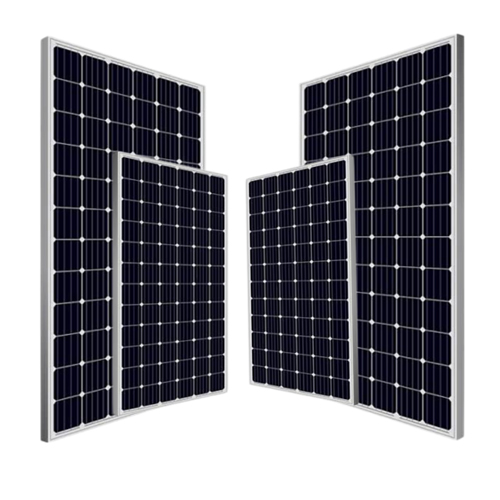
Solar Pv Modules
Solar Panel Models (Polycrystalline)
| Model (Watt/Voltage) | Basic Price (₹) | GST (@5%) (₹) | GST Paid (₹) | Price (₹) | MRP (₹) |
|---|---|---|---|---|---|
| 50 Watt/12V | 1,539 | 185 | 1,724 | 5,190 | |
| 75 Watt/12V | 2,164 | 260 | 2,424 | 6,790 | |
| 100 Watt/12V | 2,821 | 339 | 3,160 | 8,890 | |
| 165 Watt/12V | 3,927 | 471 | 4,398 | 14,990 |
Solar Panel Models (Half Cut Mono PERC)
| Model (Watt/Voltage) | Basic Price (₹) | GST (@5%) (₹) | GST Paid (₹) | Price (₹) | MRP (₹) |
|---|---|---|---|---|---|
| 550 Watt/24V (Non-DCR Bifacial) | 10,149 | 1,218 | 11,367 | 25,990 | |
| 545 Watt/24V (DCR Bifacial) | 16,649 | 1,998 | 18,647 | 25,490 |
Solar Panel Models (TOPCON Glass-to-Glass)
| Model (Watt/Voltage) | Basic Price (₹) | GST (@5%) (₹) | GST Paid (₹) | Price (₹) | MRP (₹) |
|---|---|---|---|---|---|
| 585 Watt/24V (TOPCON Non-DCR) | 11,176 | 1,341 | 12,517 | 26,990 |
Frequently Asked Question
While solar panels can still generate some electricity in shaded conditions, their efficiency and overall output will be significantly reduced. Minimizing shading and optimizing panel placement are crucial for maximizing the performance and return on investment of a solar energy system.
Regular Cleaning, Monitor for Shading, Check for Damage, Monitor Performance.
- Polycrystalline- Made from silicon crystals that are melted together.
- The silicon is poured into a mold and then cut into wafers.
- Have a bluish hue due to the light reflecting off the silicon fragments.
- The surface looks speckled or fragmented.
- Generally less expensive to produce and purchase.
Monocrystalline-Manufacturing Process:
- Made from a single continuous crystal structure.
- The silicon is formed into a single crystal using the Czochralski process, then sliced into wafers.
- Have a uniform black color.
- The single crystal structure gives them a more streamlined and uniform look.
- More expensive to produce and purchase.
- Higher manufacturing costs due to the more complex process.